India’s next manufacturing test: Can it build what goes inside products?
Source: smefutures
Article: India’s next manufacturing test: Can it build what goes inside products?
Published on: September 04, 2026
Published By: Neil Banerjee
India’s manufacturing story is moving beyond assembly, but the next challenge is building the components, materials, technology and engineering capabilities that sit deeper in the value chain.
India’s manufacturing story is moving beyond assembly, but the next challenge is building the components, materials, technology and engineering capabilities that sit deeper in the value chain.
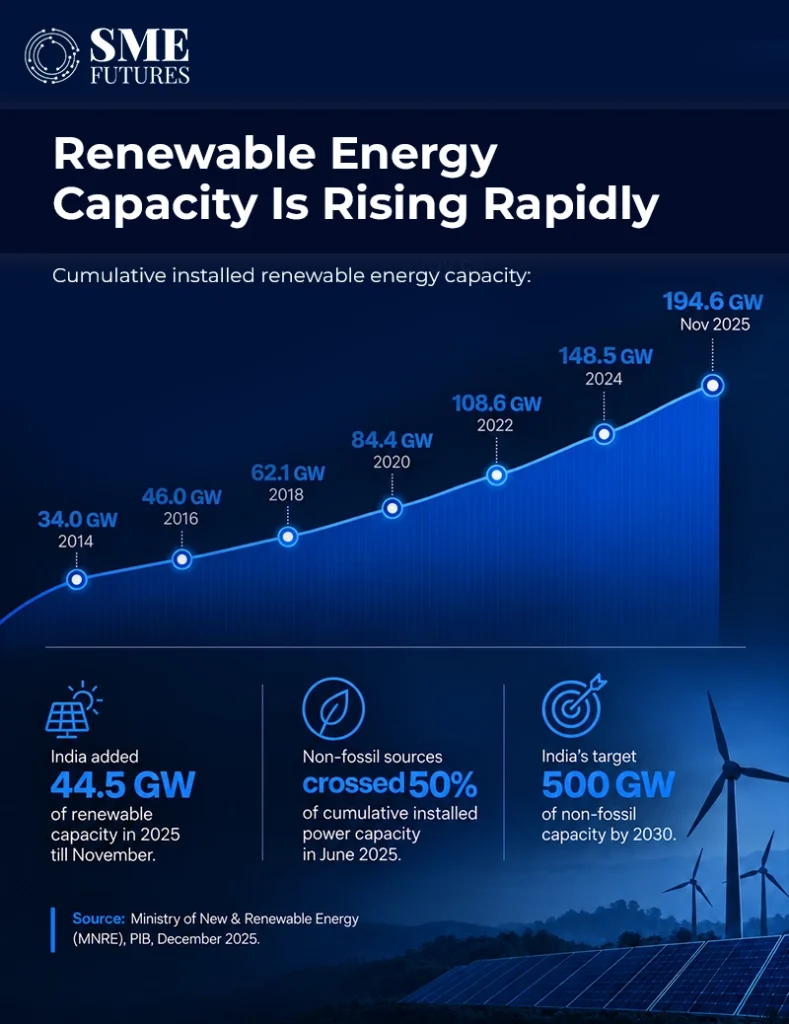
India has spent the past decade getting very good at building things at scale. Mobile phones are assembled in large numbers. Cars and construction equipment roll out of Indian factories. Solar capacity is expanding rapidly. Electric vehicles are moving from niche products towards mass adoption.
But there is a less visible question underneath that success: how much of the technology inside those products is actually being made in India?
That question is becoming harder to ignore as India’s manufacturing ambitions move into more sophisticated territory. A motor may be made here, but its rare-earth magnets may come from elsewhere. An electronic system may be assembled here, while specialised semiconductors, sensors or materials are imported. A renewable-energy product may carry a “Made in India” label, but some of its most valuable technology can still originate in overseas supply chains.
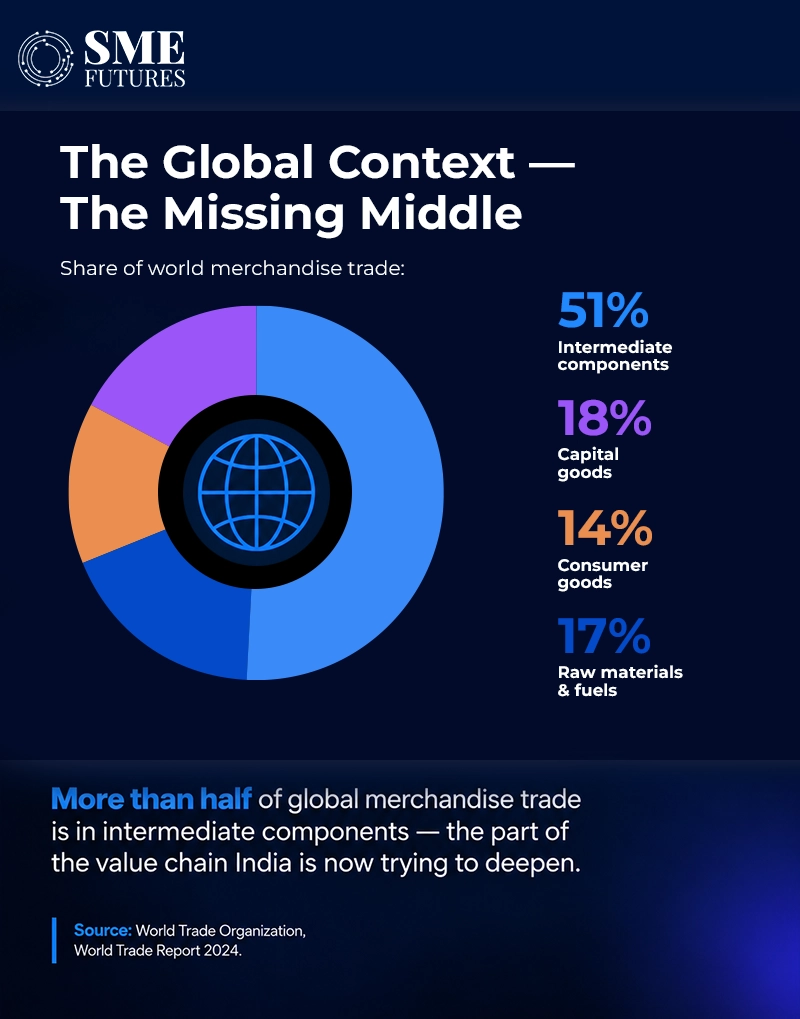
This is the missing middle in India’s manufacturing story: the materials, components, precision technologies, engineering capabilities and testing infrastructure that sit between raw inputs and finished products.
And it is becoming increasingly important because the next wave of Indian manufacturing – EVs, electronics, renewable energy, aerospace, defence, construction equipment and industrial automation – depends on precisely these layers.
“The missing middle isn’t a story about ambition or demand as India has plenty of both. It’s a story about economics and patience. Assembling a finished product is comparatively forgiving. You integrate proven parts and ship. Making the parts themselves is a different discipline altogether. It calls for heavy upfront capital, specialised machinery, deep process know-how and technical talent that takes years to build, and the payback is slow. For a long stretch, it was simply more rational for Indian firms to assemble than to go deeper,” says Naman Shah, MD & CEO of LeSol Group.
That equation, however, is beginning to change.
The assembly story is changing
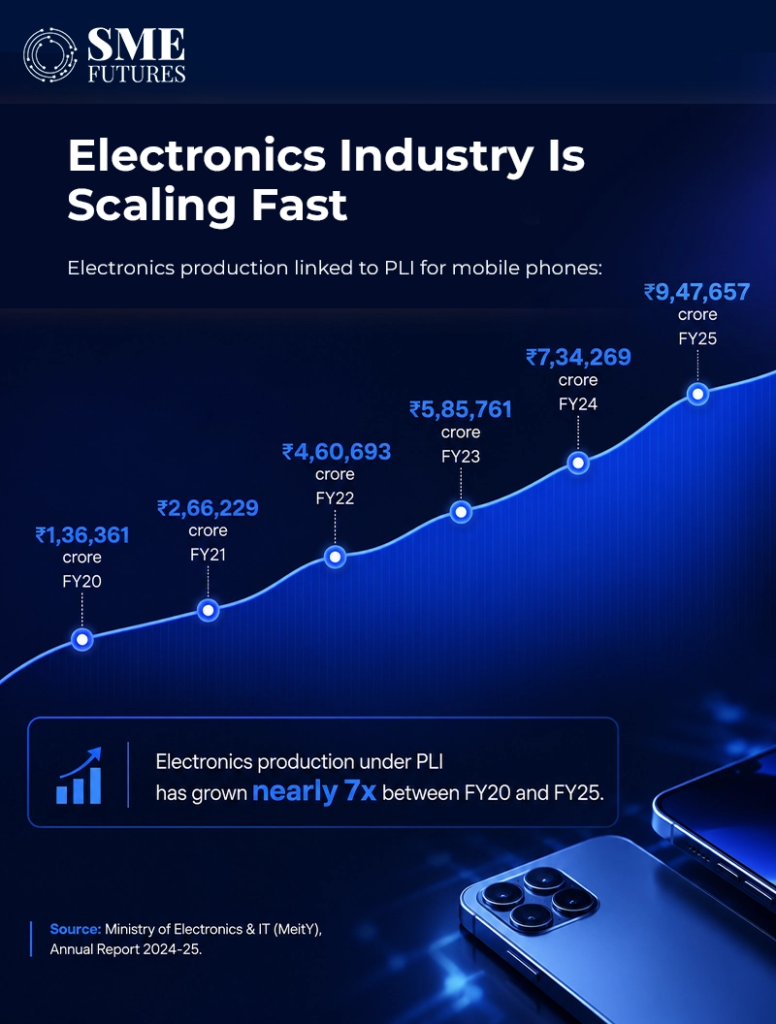
India’s electronics industry offers, perhaps, the clearest example.
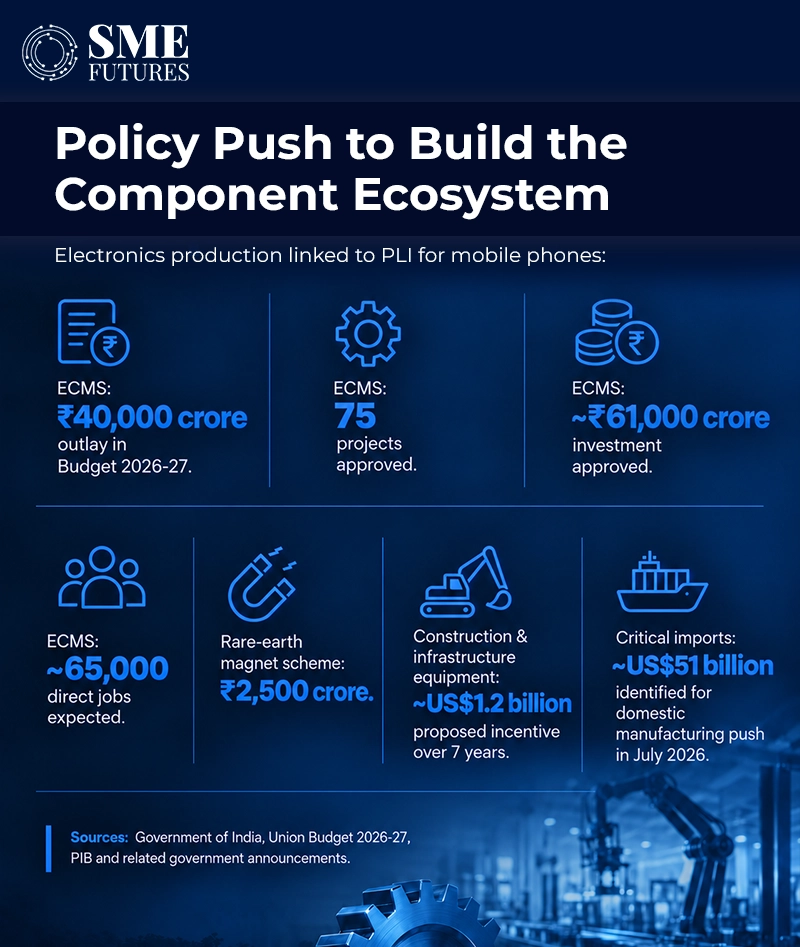
The government notified the Electronics Component Manufacturing Scheme (ECMS) in April 2025 with an initial outlay of ₹22,919 crore, specifically to build component manufacturing capacity and integrate Indian companies into global value chains. The Union Budget 2026-27 subsequently raised the scheme’s outlay to ₹40,000 crore.
The response has been substantial. By March 2026, 75 projects worth around ₹61,000 crore had been approved under the ECMS, with expectations of about 65,000 direct jobs. The approved projects span components and sub-assemblies rather than simply finished products.
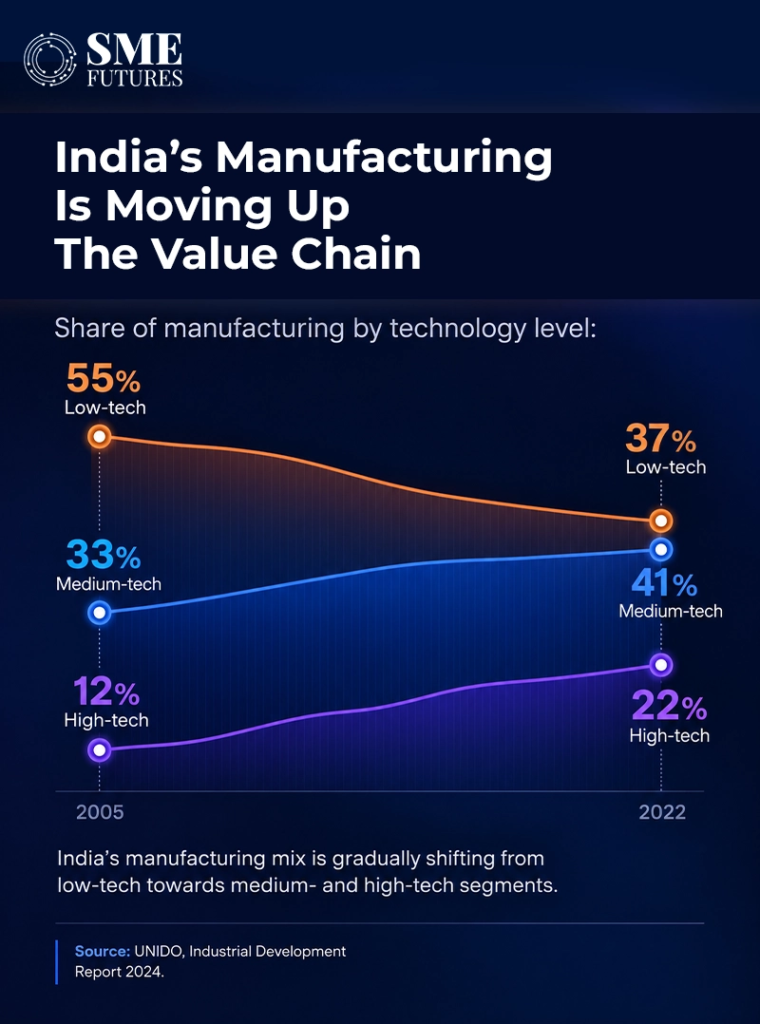
That is significant because it marks a change in the nature of the manufacturing conversation. India is no longer asking only how to get more factories. It is increasingly asking what those factories should make.
“The difference comes down to how deep the industrial base runs. Assembly is about integrating known technologies efficiently. Component manufacturing is about owning them the process, the engineering, the intellectual property, the precision, the testing. You can’t shortcut your way there; it is the product of sustained investment in R&D, materials science, process validation and skilled hands on the floor,” says Shah.
The distinction matters. A country can become a major exporter of a finished product without necessarily controlling the most valuable technologies inside it. That is precisely the vulnerability India now needs to address.
Components hiding inside the EV boom
The electric vehicle is a useful way of seeing the problem.
On the surface, an EV looks like an automotive manufacturing story. Underneath, it is an unusually dense technology system involving batteries, motors, power electronics, sensors, controllers, semiconductor-dependent systems, software and advanced materials.
For Indian EV manufacturers, the localisation challenge is, therefore, changing.
“India has made real progress in moving from an EV market to an EV manufacturing ecosystem, but the next phase of localisation is considerably more complex. The biggest gaps are no longer necessarily in mechanical fabrication or vehicle assembly; they lie increasingly in the technology-intensive layers of the EV value chain,” says Nikhil Khurrana, Founder and MD of Folks Motor.
A sensor or a specialised material may account for a tiny share of the physical size of an EV, but its failure can affect an entire system. The same is true for power semiconductors, magnetic materials and control electronics.
India’s dependence on rare-earth permanent magnets illustrates the point. The government itself has identified import dependence on rare-earth magnets as a supply-chain vulnerability for electric and hybrid vehicles and has launched a ₹7,280-crore scheme to establish 6,000 metric tonnes per annum of integrated sintered rare-earth permanent magnet capacity in India.
The scale of the challenge is already visible in government projections. An assessment by IREL (India) Ltd, DMRL and BARC puts India’s annual requirement for rare-earth permanent magnets at 8,220 tonnes by 2030, with EVs alone accounting for 3,250 tonnes and wind turbines another 1,800 tonnes.
Localisation goes deeper than “Make in India”
There is a temptation to measure localisation by how much of a finished product is assembled domestically. But the harder question is how much of the technology, components and materials underneath it are actually made in India.
Ankit Patidar, Director and CMO of Shakti Group, says the gap now sits “one or two layers upstream”.
“The gap is no longer in assembly. India has demonstrated that it can build finished products at scale and to global quality standards. The bigger gap sits one or two layers upstream in the components that go into the components,”
“We have manufactured electric motors for more than four decades and have been developing power electronics, including VFDs, inverters and controllers, in-house for several years. Even with that experience, the same bottlenecks are visible across the industry. Semiconductors for motor controllers and vehicle control units, rare-earth magnets for high-efficiency motors, and specialised materials such as magnet wire and electrical steel laminations,” he underlines.
The challenge is, therefore, not simply manufacturing these inputs, but doing so competitively, consistently and at scale. That requires capital, technical expertise, specialised suppliers and time.
Testing is another overlooked part of localisation, Patidar says.
“It is a combination of factors, but specialised materials and testing infrastructure are among the most significant constraints, with supplier depth close behind. India has built strong capabilities in precision manufacturing, including CNC machining, winding and tooling. That capability is one reason component manufacturers have been able to scale motor and controller production relatively quickly. What is harder to build at the same pace is the materials ecosystem.”
Manufacturing a component is one challenge; proving that it can perform reliably under heat, vibration, humidity and other demanding conditions is another.
The challenge becomes even deeper when the components themselves depend on materials that India does not yet process at sufficient scale.
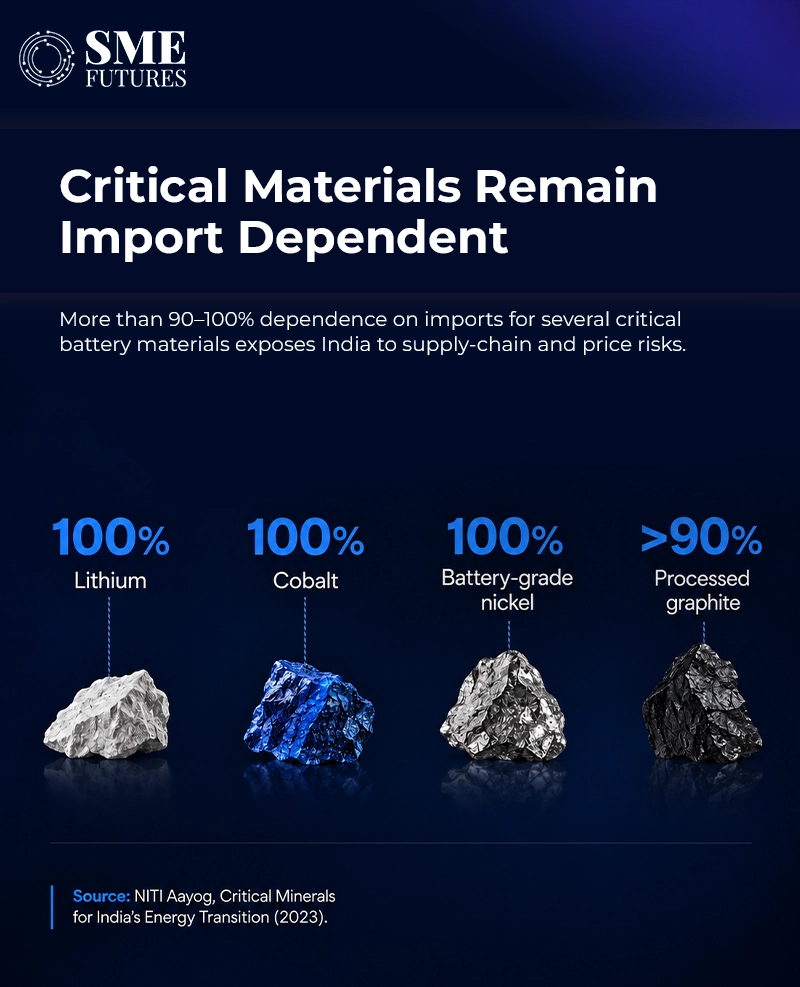
India can build batteries, EVs and solar equipment, but these industries depend on lithium, nickel, cobalt, graphite and other specialised inputs. The ability to refine and process these materials can be as important as access to the resources themselves.
Akhilesh Bagaria, Co-Founder of NavPrakriti, points to the vulnerability in battery materials.
“India faces acute vulnerabilities in securing key battery materials, with nearly 100% reliance on imports for lithium, cobalt, and battery-grade nickel, and over 90% of graphite processing occurring overseas. This exposes manufacturers to global price volatility and supply disruptions, as material costs account for 60-70% of total battery cell cost. The main risk isn’t just the lack of mineral reserves, but our near-absence of domestic refining and processing infrastructure.”
Having resources in the ground, therefore, does not automatically translate into supply-chain security. India also needs the processing, refining and material-engineering capabilities that turn those resources into usable industrial inputs.
Recycling offers another route. Used batteries can effectively become an urban mine, providing a domestic source of materials that might otherwise have to be imported.
“A robust circular supply chain can be a game-changer, enabling urban mining to meet 15-25% of India’s lithium, nickel, and cobalt demand by 2030 and reducing carbon emissions by up to 60% compared to virgin mining. However, to realise this potential, India must address critical gaps, we need organised, DG-certified collection networks for end-of-life batteries, transparent enforcement of Extended Producer Responsibility, and investment in advanced hydrometallurgical refining to recover high-purity battery-grade materials,” points out Bagaria.
Missing middle across industries
Electronics: Building the ecosystem, not just the factory
India has become a major electronics manufacturing base, but the deeper ecosystem, specialised materials, precision equipment, components, testing and process technology, is still being built.
“Electronics is not a set of independent parts; it’s a web. A single PCB pulls in specialised laminates, chemicals, connectors and equipment dozens of inputs, each with its own supply chain. If most of those inputs are imported, the manufacturer here is really just the last mile, and the real value has already been captured somewhere else. The same logic runs through semiconductors, auto-electronics, sensors, power electronics and advanced packaging,” says Shah.
But Shah says incentives alone will not determine whether global companies move deeper manufacturing to India.
“Cost alone won’t do it that’s the honest starting point. A global company moving critical processes wants confidence in a few things at once: scale, reliability, policy stability, skilled talent, and a supplier ecosystem that is genuinely complete. The government has made a serious start on all of them, but incentives are the invitation, not the reason companies stay,” avers Shah.
Construction equipment: Local by volume, import-dependent by value
India’s construction equipment industry is already highly localised by volume. But Volvo Construction Equipment India says the picture changes when measured by value.
“India’s construction equipment industry is over 95% domestically manufactured by volume, and our own experience with machines, such as the EC 210, and more recently the EC215 shows that structural fabrication, forgings, castings and mechanical assembly here are world-class, easily capable of meeting global quality standards,” says Dimitrov Krishnan, Managing Director, Volvo CE India.
“Where the gap remains is a level up the value chain. By value rather than volume, the industry still imports approximately half of its component requirement, concentrated in precision hydraulics, engines, undercarriages, transmissions and increasingly in electronics: sensors, control units and telematics hardware.” adds Krishnan.
As construction equipment becomes more sophisticated, localisation itself also changes.
“Localisation of conventional parts used to be largely a manufacturing problem, which India tackled successfully. Sensors, electronics and precision systems are a different problem all-together: they’re a design, testing and standards problem as much as a manufacturing one.”
The point extends beyond construction equipment. As products become more technology-intensive, India needs not only the capacity to manufacture them, but also the ability to design, validate and certify the technologies inside them.
Aerospace: The jump from manufacturing to engineering
Aerospace and defence make that challenge even clearer, where precision, reliability and qualification leave little room for error.
“Moving from assembly to high-value aerospace and defence manufacturing requires a fundamental shift in capabilities. It is not simply about having the right machines or manufacturing capacity; it requires building expertise across the entire product lifecycle from design and engineering to precision manufacturing, testing, qualification and lifecycle support,” says Pavan Ranga, MD & CEO, Rangsons Aerospace.
The gaps, he says, remain in areas including specialised materials, advanced electronics, precision components, testing and qualification capabilities and specialised engineering talent.
The opportunity, however, is to move beyond manufacturing to specifications and become a technology and engineering partner.
“India has a significant opportunity to move up the value chain, but this will depend on our ability to build intellectual and technological capabilities alongside manufacturing capacity. The key is to move from being a cost-competitive manufacturing destination to becoming a trusted engineering and technology partner,” says Ranga.
Renewable energy: From deployment to technology ownership
The same transition is playing out in clean energy. India’s renewable-energy build-out has created a large domestic market, but deployment capacity is only one part of the opportunity.
“The expansion of renewable energy creates opportunities well beyond power generation. Indian businesses can participate across manufacturing, project development, engineering, infrastructure, operations, maintenance and supporting services. The opportunity is particularly significant as India seeks to strengthen domestic supply chains and reduce vulnerabilities arising from dependence on imported components,” points out Anuj Agarwal, Founder and Chairman of SunBridge Solar.
The bigger question is whether that manufacturing growth translates into ownership of the underlying technology.
A solar inverter, for instance, can be assembled in India while still relying on imported power semiconductors, microcontrollers and sensors.
“Manufacturing the final product in India is an important beginning, but it does not automatically create technological self-reliance. True self-reliance means owning a larger share of the product architecture, intellectual property, firmware, control algorithms, component engineering, testing capabilities and manufacturing processes not only assembling imported technology,” says Chirag Patel, CEO of SolarYaan.
For Agarwal, that makes domestic R&D and intellectual property the next priority.
“The Indian Government has created the right policies to support the renewable energy sector in both equipment manufacturing and power generation. However, India needs to focus much more on research & development to create its own IPs in the renewable energy sector.”
Next phase will require more than more factories
The optimism among manufacturers is striking. None of the companies sees India’s opportunity as marginal, but also suggest the transition will happen automatically.
Patidar believes India can build globally competitive component ecosystems only if localisation goes beyond final assembly.
“We are optimistic, but also clear-eyed about what it will take. India has already demonstrated that this transition is possible in sectors where companies invested early, developed capabilities in-house and stayed committed for the long term.”
While Shah makes the same case from the electronics industry. “From what we have built at LeSol, I’m convinced the next phase can’t just be more production lines. It has to be engineering-led design, automation, quality, testing, and production sitting under one roof and actually talking to each other.”
From “Made in India” to “Designed and Engineered in India”
The distinction between manufacturing and technology ownership comes up repeatedly. Khurrana puts the ambition succinctly. “Our objective should be to progressively move from ‘Made in India’ to ‘Designed, Engineered and Made in India.”
That is a harder proposition than import substitution. It means developing the intellectual property, materials knowledge, product engineering and testing capabilities behind the finished product.
Ranga frames it similarly from aerospace and defence. “The key is to move from being a cost-competitive manufacturing destination to becoming a trusted engineering and technology partner.”
Vipul Bhandari, Assistant Vice President, Supertron Electronics, sees the same shift in electronics. “India’s next phase of electronics growth will depend on moving beyond assembly towards greater ownership of design, engineering, components and manufacturing.”
Across industries, the transition is the same: from making products in India to owning more of what makes those products possible.
The road ahead
Policy is beginning to respond to this deeper challenge. The ECMS is aimed at building a domestic component ecosystem and integrating Indian manufacturers with global value chains, while the government is also working to build domestic rare-earth magnet capacity for EVs, wind turbines and other applications. The broader manufacturing push is growing more targeted too, with the government examining critical imports and capability gaps across sectors — construction equipment among them, where policy is shifting toward high-value, technologically advanced equipment rather than volume alone.
The direction is clear, but policy can only create conditions; it cannot manufacture engineering knowledge, supplier relationships or quality culture overnight.
For years, India’s manufacturing ambition was simple: more factories, more investment, more jobs, more exports. That still matters. But the next stage is harder and it’s not whether India can build a vehicle, a solar system or an electronic device, but whether it can build the sensor inside it, the material inside the sensor, the semiconductor controlling it, and the equipment and technology needed to test it.
Not how much India can assemble, but how much of the technology underneath it, it can own.